The short verdict
A capable exchange for accessing assets you cannot get elsewhere — and the wrong place to leave a balance sitting.
- Security architecture & track record 5.2
Standard controls are all present. The December 2021 hot-wallet breach is a permanent mark, and the reimbursement — while genuinely creditable — does not restore the perimeter assumption.
- Reserve & liability transparency 5.0
Behind the venues that publish regular third-party-verified attestations covering both sides of the balance sheet.
- Asset breadth 9.0
The genuine strength. Listing coverage extends far into the long tail, including tokens tier-one venues decline for compliance reasons.
- Fees on liquid pairs 7.0
Competitive published tiers with
BMXdiscounts. Only relevant on pairs where the book is deep enough for the fee to be the dominant cost. - Liquidity & execution quality 5.5
Fine on majors. On small caps, slippage routinely dwarfs any fee advantage — check the book, not the last price.
- Mobile app quality 7.5
Genuinely usable. Fast order entry, workable charts, no obvious dark patterns pushing leverage at new accounts.
- Regulatory footing 4.8
Offshore, with market access that varies by country and US state and can change with little notice.
- Support responsiveness 5.0
Ticket queues and templated first replies. Adequate on routine issues, stressful on urgent ones.
Scores are this site's independent editorial assessment based on public incident records, published documentation and hands-on use. They are not supplied, reviewed or endorsed by BitMart.
What genuinely works
- Genuine long-tail access. If a small-cap token is listed anywhere reputable, there is a decent chance it is here. For some readers that is the entire reason to hold an account.
- The 2021 reimbursement was honoured in public. Management committed company funds to cover user losses rather than socialising them. That is a meaningfully better response than several contemporaries managed.
- The core security toolkit is present. Authenticator
2FA, anti-phishing codes and withdrawal address whitelisting are all available — you just have to switch them on. - The mobile app is competent. Order entry, charting and portfolio views work; it is not a wrapper around a mobile website.
- Fee discounts via
BMXare real, and the tier structure is published rather than negotiated case by case.
What we would flag to a friend
- A nine-figure hot-wallet breach is on the permanent record. December 2021, and no subsequent posture statement can undo the demonstration that the perimeter was penetrable.
- Reserve transparency lags the top tier. Attestations without a verified liability side tell you much less than the word "proof" implies.
- Order-book depth on the long tail is thin. The slippage on a mid-size exit will routinely exceed everything you saved on fees.
- Regulatory footing is offshore and patchy. Availability varies by country and by US state, and can change with little notice.
- Support is ticket-based and slow by the standards of a licensed venue, which matters most on exactly the day it matters most.
- The fee discount is paid for in counterparty risk. Holding an exchange token to cut fees concentrates your exposure to that exchange.
Who this is actually for
Reviews go wrong when they try to answer "is it good?" instead of "good for whom?". BitMart is a tier-two global exchange competing on breadth. It exists because the tier-one venues — Coinbase, Kraken, and the regulated arms of the larger operators — have listing committees that will not touch most of what trades. If you want exposure to something outside the top two hundred assets by market cap, you end up at a venue like this one, or on a DEX.
That produces three clean reader profiles:
- You want a specific long-tail token. This is the legitimate use case. Open an account, verify, size the position deliberately, execute, and withdraw what you are not actively trading.
- You want a general-purpose exchange for majors. There are better options. On BTC, ETH and the large stablecoins, a licensed venue in your own jurisdiction gives you better execution, better recourse and a clearer regulatory position at broadly similar cost.
- You want somewhere to park savings. No exchange is the answer to this. See the
custody explainer — and then read up on hardware wallets and
ERC-4337smart accounts.
Security audit: the December 2021 breach and what it means now
On 4 December 2021, attackers drained BitMart's hot wallets on the Ethereum and BNB Chain networks. Blockchain analytics firm PeckShield put the loss at roughly $196 million; BitMart's own statement described a figure nearer $150 million, with the difference attributed to how the drained tokens were valued. The attack was a straightforward hot-wallet compromise — a stolen private key, not an exotic smart-contract exploit.
BitMart suspended withdrawals, publicly stated that it would cover the losses from its own funds rather than imposing a haircut on users, and restored service in stages. Judged against how similar events have gone elsewhere, that response was near the better end of the range: the company took the loss onto its own balance sheet.
The part that does not go away: reimbursement fixes the balance sheet, not the threat model. What the breach demonstrated is that the operational separation between hot and cold storage — and the key-management around it — was penetrable at scale. A company can improve after that. It cannot un-demonstrate it.
What we would want to see, and what is actually published
| Control | Why it matters | Status as published |
|---|---|---|
| Hot/cold segregation | Limits the blast radius of a single key compromise | Claimed; ratios not disclosedMost venues do not publish the split — this is an industry-wide gap |
| Multi-party computation / HSM key custody | Removes any single point of key theft | Described in general terms |
| Third-party penetration testing | Independent verification rather than self-assessment | No regular public report |
| Bug bounty programme | Turns researchers into an early-warning system | Operated |
| Withdrawal address whitelisting | A compromised session still cannot send funds anywhere new | Available — enable it |
| Anti-phishing code | Makes fake "BitMart" emails trivially identifiable | Available — enable it |
| Hardware key / passkey 2FA | The only 2FA that cannot be phished | Authenticator-based 2FA is the practical ceiling |
| Public incident post-mortems | Shows what changed after a failure, in technical detail | Not a routine practice |
That last row is the honest summary of the whole section. The gap between BitMart and a tier-one venue is less about which controls exist and more about how much of it you can independently check. You are being asked to take a great deal on trust.

Proof of reserves, honestly read
After 2022, publishing a reserve attestation became an industry hygiene requirement. It is also the single most over-interpreted document in crypto. Here is how to read one without being reassured by something that is not reassuring.
- Reserves alone prove nothing. Showing that you control 10,000 BTC is meaningless without showing that customers are owed fewer than 10,000 BTC. A solvency claim requires both sides.
- Check who attested it. A Merkle-tree snapshot self-published by the exchange is a different artefact from an engagement signed by a named accounting firm. Both are common; only one carries external liability.
- Check the date. A snapshot proves control of assets at one instant. Assets can be borrowed for the snapshot and returned afterwards — this has genuinely happened.
- Check whether you can verify your own inclusion. A well-built proof lets you confirm that your balance was in the liability tree. If there is no user-facing verification tool, the exercise is a press release.
Fees and the real cost of a trade
BitMart publishes a conventional tiered maker/taker schedule: your rate falls as 30-day volume
rises, with an additional discount for holding or paying fees in BMX. The structure
is normal and the published rates are competitive with peers.
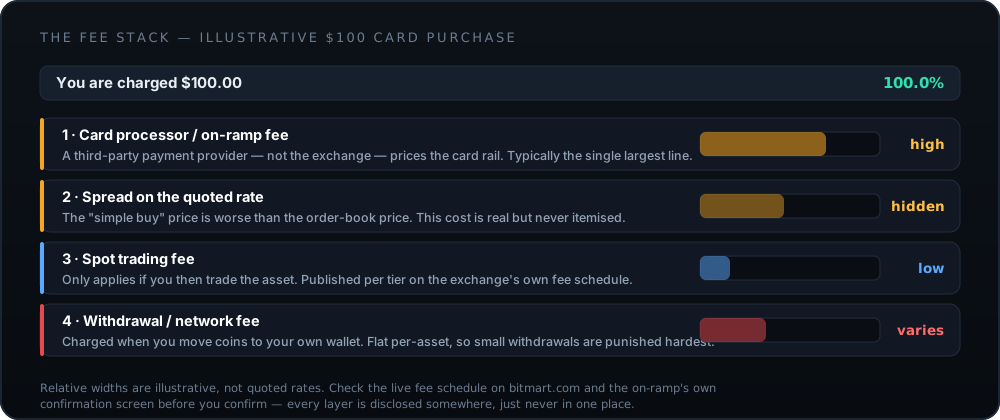
That published rate is also, for most readers, not the dominant cost. Four things are charged against a typical retail purchase, and only one of them appears on the fee page:
A worked example
Suppose you buy $500 of a mid-cap token with a card and then move it to your own wallet. Your actual cost is: the card processor's fee, plus the spread between the simple-buy quote and the order-book mid, plus the taker fee if you route through the book, plus the flat network withdrawal fee. On a $500 ticket, the withdrawal fee alone can exceed the trading fee by several multiples if you exit on a congested network.
The optimisation, in order of impact: fund by bank transfer rather than card; place limit orders rather than market orders; batch withdrawals instead of moving funds repeatedly; and choose a low-fee network for the exit leg. Doing all four routinely saves more than any fee tier ever will.
Liquidity: the fee nobody quotes you
This is the section most reviews skip, and it is the one that costs real money. A trading fee of 0.2% is trivially quantifiable. Slippage on a thin book is not, and it is frequently ten times larger.
Before you buy anything outside the majors on any broad exchange, do this:
- Open the order book — not the price chart — and look at the depth on both sides within 2% of the mid price.
- Ask whether your intended position size fits inside that depth. If your exit would consume most of the visible bids, you do not have a position, you have a trap.
- Check the 24-hour volume against the market cap. Volume that is a large multiple of a small market cap often indicates wash trading rather than genuine interest.
- Check whether the asset trades anywhere else. Single-venue listings mean single-venue exit risk: if the pair is delisted, your position becomes a withdrawal problem.
A price is only real at a size. The last traded price of an illiquid token tells you what one person paid for a small amount. It tells you nothing about what you will receive when you want out, and the gap between those two numbers is where most retail losses on long-tail assets actually occur.
The app itself
Judged purely as software, the BitMart mobile app is fine. Order entry is quick, the chart is workable, portfolio and order history are where you expect them, and biometric unlock works properly on both platforms. It is a native application rather than a wrapped web view, and it performs like one.
Three observations from using it:
- The simple-buy flow is the expensive flow. It is also the most prominent one, as it is on every exchange app. Learning the spot trading screen takes twenty minutes and pays for itself immediately.
- Security settings are buried, as usual. Whitelisting and the anti-phishing code live several taps deep in account settings. Set them up on day one — our login and 2FA guide walks through each.
- Push notifications are worth enabling for security events only. Login alerts and withdrawal confirmations are genuinely useful. Price alerts on a volatile asset are a behavioural trap.
Installation is the one place where the app carries real risk, and it has nothing to do with BitMart's code: counterfeit listings and sideloaded APKs. Our download and verification guide covers the checks.
Regulatory footing in 2026
The regulatory picture is where the gap between tier-one and tier-two venues has widened most since 2024.
- Europe. Under MiCA, a platform either holds an authorisation in a named EU member state and passports across the bloc, or it steadily loses lawful access to those markets. This is the single most useful question a European reader can ask about any venue, and the answer is binary.
- United States. Federal
MSBregistration with FinCEN is a filing, not a licence. The binding constraint is state-level money transmitter licensing, which is why availability differs state by state — and why New York, with its BitLicense regime, is the sharpest line of all. See BitMart USA and BitMart in New York. - Tax reporting. Form
1099-DAreporting is in force for US-facing brokers, with cost-basis reporting phasing in. Keep your own transaction records regardless of what any platform reports. - Travel rule. Identifying-information requirements on transfers above threshold are now standard across major jurisdictions, which is why withdrawals to unhosted wallets sometimes trigger extra questions. That is compliance, not obstruction.
Where BitMart ranks
| Tier | Characteristics | Where BitMart sits |
|---|---|---|
| Tier 1 — licensed majors | Named-jurisdiction licences, audited reserves, deep books, real support | Not here |
| Tier 2 — large global venues | Very wide listings, competitive fees, offshore base, variable transparency | Solidly hereCompetitive within the tier on breadth |
| Tier 3 — regional & niche | Narrow markets, shallow books, limited disclosure | Above this |
| Tier 4 — avoid | Anonymous operators, withdrawal complaints, no verifiable history | Clearly not this |
The absolute verdict
Specific enough to act on, and specific enough to argue with:
- Choose BitMart if…
- you want a specific asset that tier-one venues do not list, you have checked the order-book depth for your intended size, and you intend to move anything you are not actively trading into your own wallet the same week.
- Choose a licensed tier-one exchange if…
- you are trading majors, this is your fiat on-ramp, you want recourse that involves a regulator in your own country, or you simply do not want to think about counterparty risk every time you open an app.
- Choose self-custody if…
-
the holding period is longer than a few weeks. A hardware wallet, or an
ERC-4337smart account with social recovery, removes the entire category of risk this review has been describing.
The honest summary: BitMart is a real exchange doing a real job, in a tier where the job comes with real risks. It is neither the scam its detractors claim nor the safe haven its referral pages imply. Use it deliberately, for a defined purpose, with a defined balance — and the risks stay proportionate to what you stand to gain.
Frequently asked questions
How does BitMart rank against Binance, Coinbase or Kraken?
Below all three on the dimensions that matter for safety — reserve transparency, regulatory footing, order-book depth and support responsiveness — and above them on breadth of listings. That is the whole trade, and it is a coherent one: BitMart occupies the tier of large offshore exchanges whose competitive advantage is access to assets that more conservative venues will not touch.
The mistake is treating a ranking as a single number. A venue can be the right choice for a specific $200 trade and the wrong choice for a $50,000 balance sitting idle for a year.
Did BitMart really get hacked, and did users get their money back?
Yes. On 4 December 2021 attackers drained BitMart's hot wallets on the Ethereum and BNB Chain networks. Blockchain security firm PeckShield initially put the total near $196 million; BitMart's own statement described a figure closer to $150 million, attributing the gap to how the tokens were valued. Either way it was one of the largest exchange breaches of that year.
BitMart said it would compensate affected users from company funds and use its own reserves rather than a socialised-loss mechanism. Withdrawals were suspended during the response and later restored. The reimbursement commitment is on the public record; as always, you should read the company's own statements at bitmart.com rather than relying on any third-party summary, including ours.
Is BitMart a scam?
No — and it is worth being precise about the word. A scam takes deposits with no intention of honouring withdrawals. BitMart has operated since 2017, processes withdrawals, publishes fee schedules and reimbursed users after a breach. Those are not the behaviours of an exit scam.
The real risks are ordinary custodial ones: a security incident, a regulatory action that restricts your market, an account freeze during a compliance review, or thin liquidity on an asset you need to exit. Those risks are entirely manageable if you treat the platform as a trading venue rather than a vault.
What are BitMart's trading fees?
BitMart publishes a tiered maker/taker schedule for spot and futures on its own website, with discounts for holding or paying in BMX and lower rates at higher 30-day volume. Because those tiers are revised periodically, quoting a fixed percentage here would be actively misleading within a few months.
The reliable approach: open the fee schedule at bitmart.com, find your volume tier, and then add the two costs that never appear on that page — the spread on any "simple buy" flow, and the flat withdrawal fee for the network you exit on. Those two frequently exceed the trading fee itself.
Is my money insured on BitMart?
Not in the sense most people mean. There is no FDIC, FSCS or equivalent deposit insurance on cryptoasset balances at any exchange — those schemes cover bank deposits, not crypto. Some venues maintain a self-funded insurance pool or reserve fund; whatever exists is a company commitment, not a government guarantee, and its size relative to total customer assets is the number that actually matters.
Assume you are unsecured. That assumption leads to correct behaviour: keep trading balances small and hold long-term positions in self-custody.
How long do BitMart withdrawals take?
In normal conditions, a crypto withdrawal is processed within minutes and then takes as long as the chosen network needs to confirm. Delays cluster around three causes: a compliance review triggered by pattern or amount, a paused network during a chain upgrade or congestion event, and incomplete KYC for the tier you are trying to withdraw at.
The most common self-inflicted delay is the third. Complete verification before you need it, not on the day you want to exit.