Independent audit · No affiliation with BitMart

The BitMart exchange app, examined the way a security person would

Not a brochure. This is what the app does well, what it costs once every layer is counted, what its 2021 breach actually tells you, and the five checks worth running before you send money anywhere — BitMart or otherwise.

Every figure on this site is attributed. Specifications change — verify against bitmart.com before you act.

A stylised hand holding a Bitcoin token, representing custody of a digital asset
Holding the coin is the whole question. On an exchange, someone else is holding it for you.
  • Custody model Custodial The exchange holds the keys, not you
  • Major incident Dec 2021 ~$196M hot-wallet breach; reimbursement pledged
  • Platforms iOS · Android · Web Verify the publisher before installing
  • Our rating 6.4 / 10 Capable venue, unresolved trust questions

Start here

Before anything else: who is holding your coins?

Almost every expensive mistake in crypto traces back to one confusion. Clear it up in the next ninety seconds and the rest of this site will make sense.

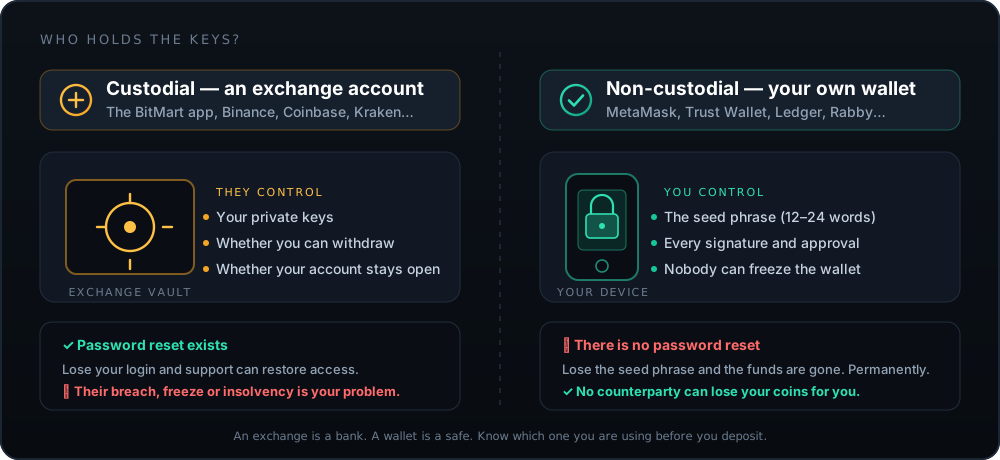
An exchange — BitMart, Binance, Bybit, Coinbase, any of them — works like a bank. You deposit, and the number on your screen becomes an IOU. The exchange holds the actual private keys in its own wallets and nets your trades internally. That arrangement buys you real conveniences: password resets, customer support, deep order books, and someone else worrying about gas.

A non-custodial wallet — MetaMask, Trust Wallet, Rabby, a Ledger device — works like a personal safe. You hold a seed phrase, usually twelve or twenty-four words, and that phrase is the money. No company sits between you and the blockchain. Nobody can freeze you, and nobody can rescue you.

Side-by-side comparison: a custodial exchange holds your private keys and can restore access but can also freeze or lose your funds; a non-custodial wallet stores the seed phrase on your device, giving total control and no recovery option
The distinction that decides what can go wrong. Neither model is "safer" in the abstract — they fail in completely different directions.

The one-sentence version: an exchange can lose your money for you; a wallet lets you lose it yourself. Choose deliberately, and do not keep long-term holdings in the place designed for short-term trading.

This is not a theoretical concern. The people worst hurt by every exchange failure of the last decade were not traders who lost a bet — they were holders who used a trading venue as a savings account because it was the interface they already had open. The BitMart app is a reasonable place to buy and trade. It is not a place to store a retirement.

Product surface

What the BitMart app actually gives you

  • A broad, long-tail listing

    BitMart's central pitch has always been breadth: it lists a very large number of assets, including small-cap tokens that never reach tier-one venues. That is genuinely useful for access — and genuinely dangerous for liquidity, because a thin book means your exit price may be nothing like the last traded price.

  • Spot, futures and earn products

    Beyond simple buying there is margin, perpetual futures and a range of yield products. Availability of each depends on your verified region — derivatives in particular are restricted in several jurisdictions, including for most US users.

  • Card and third-party fiat on-ramps

    You can fund with a card, and on iOS through Apple Pay, but the charge is handled by an external payment processor rather than the exchange. That matters for pricing, for declines and for who you contact when something goes wrong.

  • A native token with fee discounts

    BMX, the platform token, reduces trading fees when held or used to pay them. Read that structure carefully: a discount that requires holding an illiquid exchange token is a discount you pay for with concentrated counterparty risk.

  • Standard 2FA and withdrawal controls

    Authenticator-based 2FA, anti-phishing codes and withdrawal address whitelisting are all available. They are off by default in the sense that nobody makes you enable them — see our login hardening guide.

  • KYC tiers that gate real limits

    Withdrawal ceilings and fiat access scale with identity verification level. Plan for this before you deposit: discovering a limit at the moment you want to exit is a uniquely unpleasant experience.

Comparison

Where an app like BitMart sits against the alternatives

Three different tools for three different jobs. Most people need at least two of them.

Custodial exchange vs. tier-one venue vs. self-custody
DimensionBitMart-style broad exchangeTier-one regulated exchangeNon-custodial wallet
Who holds the keysThe exchangeThe exchangeYou
Asset breadthVery wide, incl. long tailAccess to tokens majors will not listCurated, conservativeListings are a compliance decisionAnything on-chainIncluding outright scams — no filter
Liquidity on small capsHighly variableCheck book depth, not the ticker priceDeep where listedN/A — depends on the DEX pool
Recovery if you lose accessSupport can restoreSupport can restoreNone, unless smart walletAccount abstraction adds social recovery
Counterparty riskReal and concentrated2021 breach on recordReal but better hedgedNone
Regulatory footingOffshore, patchy by stateLicensed in named marketsMiCA in the EU, MTLs in the USNot applicable
Best used forAccessing assets you cannot get elsewhereFiat on-ramp and core tradingHolding anything long term
Structural comparison compiled by BitMartExchange.app. Exchange-specific details are summarised from each operator's public documentation, including bitmart.com. Categories are editorial, not vendor-supplied.

Read that table as a workflow rather than a contest. The rational setup for most people is: use a well-capitalised, properly licensed venue for the fiat on-ramp; use a broad exchange only when you specifically need an asset that is not listed anywhere better; and move anything you intend to hold for more than a few weeks into a wallet you control.

Pre-flight

Five checks before you deposit anywhere

Not BitMart-specific. Run these on any venue and you will avoid the overwhelming majority of preventable losses.

  1. Confirm you are on the real domain, from your own bookmark

    Type the address yourself once, bookmark it, and use only that bookmark forever after. Phishing operators buy search ads against exchange brand names, and a lookalike login page is indistinguishable from the real one by eye. Never reach a login screen from an email, a DM or an ad.

  2. Turn on authenticator-based 2FA — not SMS

    SMS codes are defeated by SIM-swap attacks, which are cheap, common and require nothing more sophisticated than talking to a carrier support agent. A TOTP app takes two minutes to set up. If the venue supports a hardware key or passkey, use that instead. Full walkthrough in the login guide.

  3. Whitelist your withdrawal addresses

    Address whitelisting means that even a fully compromised session cannot send funds somewhere you have not pre-approved, usually with a delay on adding new destinations. It is the single highest-value setting on any exchange and almost nobody enables it.

  4. Send a test transaction before the real one

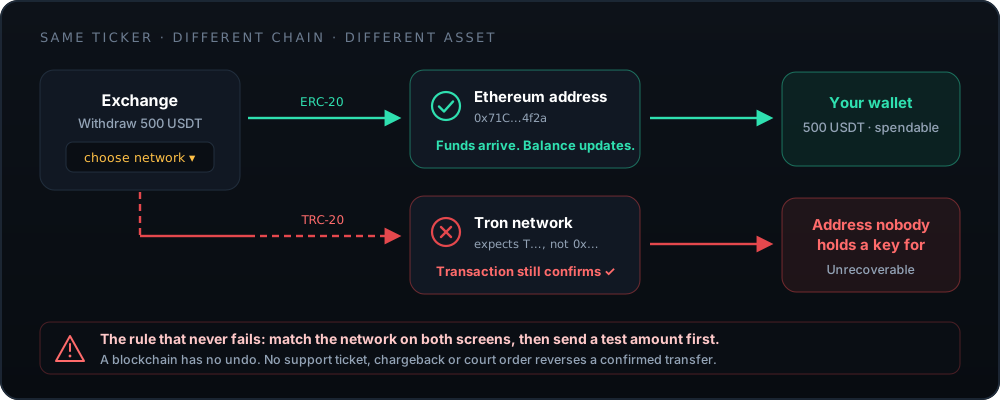
    The first time you withdraw to a given address, send the minimum. Confirm it lands. Then send the rest. This costs one extra network fee and defends against the most permanent error in crypto — see the network-mismatch trap below.

  5. Decide in advance what stays and what leaves

    Write down a number. "Anything above X moves to cold storage on the first of the month." Without a rule, balances drift upward on the platform you happen to be logged into, and that drift is how people end up with life-changing sums on a trading venue.

Diagram showing that sending USDT over the Tron network to an Ethereum address results in a confirmed but unrecoverable transaction, while matching networks delivers the funds correctly
The network-mismatch trap. The transaction succeeds — that is what makes it so cruel. The tokens simply exist at an address on a chain where nobody holds the key.

Funding routes

How to get money in — and what each route really costs

Convenience and cost run in opposite directions, without exception. The fastest method is always the most expensive, because speed on a payment rail is something someone is being paid to provide.

Fiat funding routes compared
RouteSpeedRelative costMain failure modeGuide
Debit cardInstantHighest3-D Secure decline; bank treats it as a cash advanceDebit card guide
Apple PayInstantHighestSame processor as card, one less formCard behind the wallet is declined; region unsupportedApple Pay guide
PayPalVariesHigh / often unavailableReversal risk gets accounts frozen on both sidesPayPal guide
Bank transfer1–3 daysLowestName mismatch between bank and exchange account
Stablecoin depositMinutesNetwork fee onlyWrong network — funds lost
Speed and cost bands are editorial generalisations across card processors and banking rails, not quoted rates from any single provider. Exact fees are disclosed by BitMart and its payment partners at the point of confirmation; see bitmart.com for the current schedule.
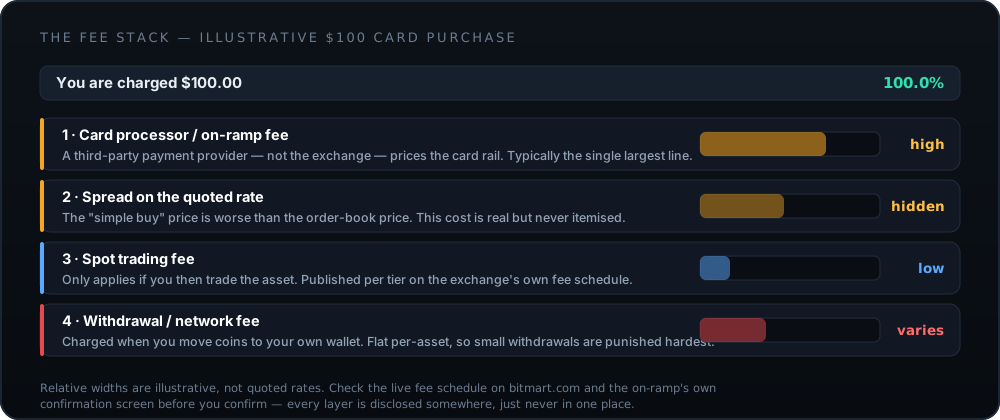
Breakdown of a card purchase showing four cost layers: payment processor fee, spread on the quoted rate, spot trading fee and network withdrawal fee
Four layers, disclosed in four different places. This is why "zero-fee" marketing on a simple-buy screen is technically true and practically meaningless.

If you are moving a meaningful amount, the bank-transfer route is worth the wait almost every time. Card rails make sense for small, urgent purchases and for nothing else.

The 2026 picture

What has actually changed in the last two years

MiCA has split the European market in two

The EU's Markets in Crypto-Assets regime moved from theory to enforcement, and the effect is stark: platforms with a licence passport across the bloc, and platforms without one steadily lose access to it. For European users this is the most useful single filter available — ask whether a venue holds an authorisation in a named EU member state, not whether it "complies with regulations" in the abstract.

Account abstraction made self-custody survivable

Smart-contract wallets built on ERC-4337 support social recovery, spending limits, session keys and sponsored gas. The old objection to self-custody — one lost seed phrase and everything is gone — now has a real answer. If you rejected wallets in 2022 on those grounds, the calculation has genuinely changed.

US tax reporting became automatic

Broker reporting on Form 1099-DA means US-facing platforms now report disposals directly to the IRS, with cost-basis reporting phasing in behind it. The practical upshot: keep your own records, because reconciling an exchange's basis calculation after the fact is far harder than logging trades as you go.

Proof of reserves became table stakes — and stayed shallow

Post-2022, publishing a Merkle-tree reserve attestation became standard. It is better than nothing and much less than an audit: reserves without a matching, verified statement of liabilities prove very little. When you read one, look for who attested it, whether liabilities are covered, and how recently it was refreshed.
The parts a referral page will not mention

We earn commission when readers open accounts through partner links on this site. That creates an obvious incentive to be upbeat, so here is the counterweight, stated plainly.

  • The 2021 breach is a permanent part of the record. Roughly $196 million left BitMart's hot wallets in December 2021. The company committed to covering losses from its own reserves, which is materially better than the alternative — but a venue that has been drained once has demonstrated that its hot-wallet perimeter was penetrable, and no subsequent statement can un-demonstrate it.
  • Long-tail listings cut both ways. The breadth that makes a broad exchange useful also means listing standards are, necessarily, looser. Thin order books produce slippage that dwarfs any fee saving, and a token you can buy is not necessarily a token you can sell at that price.
  • Withdrawal fees on congested networks are brutal for small balances. A flat per-asset withdrawal fee is a rounding error on $10,000 and a serious tax on $80. If you are moving small amounts, choose your network deliberately — an L2 or a low-fee chain rather than Ethereum mainnet.
  • Support quality is the usual offshore-exchange story. Expect ticket queues and templated first responses. Anyone who contacts you first, unprompted, claiming to be support is running a scam — with no exceptions worth entertaining.
  • Regional eligibility can change under you. Offshore venues adjust market access in response to licensing pressure, sometimes at short notice. Do not build a workflow that assumes indefinite access from your country.

Frequently asked questions

Is the BitMart exchange app safe to use?

"Safe" needs splitting into two questions. The app binary from the official App Store and Google Play listings is the genuine article — the risk there is counterfeit clones, which our download and verification guide shows you how to rule out in about ninety seconds.

The platform is a different question. BitMart is a custodial exchange, which means it holds your private keys. It also suffered a hot-wallet breach in December 2021 in which roughly $196 million in assets was drained; the company publicly committed to reimbursing affected users from its own funds. That history does not make it uniquely dangerous — most large venues have an incident file — but it does mean the ordinary rule applies with force: keep on any exchange only what you are actively trading, and move long-term holdings to self-custody.

Does BitMart hold my private keys?

Yes. Like every centralised exchange, BitMart operates an omnibus custody model: your on-screen balance is a database entry representing a claim on assets the exchange controls. You never touch a private key, and you cannot sign a transaction yourself.

The practical consequence is that account access and asset ownership are the same thing. If the account is frozen, phished or compromised, the coins move with it. A non-custodial wallet inverts this — you hold the seed phrase, so nobody can freeze you out, and nobody can help you if you lose it.

What does it actually cost to buy crypto in the BitMart app?

There is no single number, and any site quoting one is oversimplifying. Four separate layers apply: the payment-processor fee on the card or Apple Pay rail, the spread built into the "simple buy" quote, the spot trading fee if you then trade, and a flat network withdrawal fee when you move coins out.

BitMart publishes its spot and futures fee tiers on its own fee schedule at bitmart.com, and those tiers change. The card rail is priced by a third-party processor, not by BitMart, and is usually the largest single line. Our debit-card guide walks through the arithmetic with a worked example.

Can people in the United States use BitMart?

Partly, and it changes. BitMart has historically served US customers with a reduced product set, and US access to derivatives and some tokens is restricted. State-level money-transmitter licensing is the binding constraint rather than federal registration — which is exactly why New York, with its BitLicense regime, is treated separately by nearly every offshore venue.

Because eligibility is set by BitMart and shifts with its licensing position, always confirm your own status on the official site before funding an account. We cover the structure in BitMart USA availability and BitMart in New York.

Is this the official BitMart website?

No. BitMartExchange.app is an independent research site with no affiliation to BitMart. We publish analysis, guides and comparisons; we cannot access accounts, reset passwords, unfreeze withdrawals or recover funds. For anything account-related you must contact BitMart through its own support channels, reached from bitmart.com directly — never through a link in an email, a DM or a search advertisement.

Should I use an exchange app or a self-custody wallet?

Both, for different jobs. An exchange is the on-ramp and the trading venue: it converts fiat to crypto, offers deep order books and handles the regulatory paperwork. A self-custody wallet is where value should sit once you are no longer actively trading it.

The 2026 wrinkle is that smart-contract wallets built on ERC-4337 account abstraction have made self-custody meaningfully less brutal — social recovery, spending limits and gas sponsorship remove the "one mistake and it is gone forever" cliff that kept people parked on exchanges. If the seed phrase was your reason for staying custodial, that reason is weaker than it was two years ago.